
Open document formats: files you can leave with
Open document formats decide whether you can leave a software vendor. What ODF and OOXML are, which governments are switching, and what a company should do.
Part of the guide: Replacing the vendor stack: office, HR, chat and cost

The short answer: a file format is open when anyone may read its published specification and build software for it without paying a fee or asking permission. That is what lets you open a document in ten years, or in another vendor's product next month. There are two standardised office formats: ODF, an open standard whose latest version was approved in December 2025, and OOXML, the standardised form of the Word, Excel and PowerPoint formats. Governments in Europe have moved towards open formats and open software since 2024, with real savings in one case and a quiet reversal in another. For a company, the practical rule is modest: keep your working files in a standard format on storage you control, and test your exit once.
What makes a file format "open"?
Three things. The specification is published. A standards body maintains it, not a single company. And anyone can implement it without royalties.
India's own Policy on Open Standards for e-Governance, issued in November 2010, puts the purpose well. Open standards promote "technology choice" and avoid "vendor lock-in", and aim for "reliable long-term accessibility to public documents and information". That policy binds government systems, at the level of interfaces and data archiving. It does not apply to private companies. Its reasoning does.
The opposite of an open format is one that only its maker's software can read reliably. Your documents are then yours on paper and theirs in practice.
What is the difference between ODF and OOXML?
Both are standards. They differ in origin and in who uses them.
| ODF | OOXML | |
|---|---|---|
| Full name | Open Document Format for Office Applications | Office Open XML |
| File types | .odt, .ods, .odp | .docx, .xlsx, .pptx |
| Standards bodies | OASIS, and ISO/IEC 26300 | Ecma (ECMA-376), and ISO/IEC 29500 |
| Latest status | ODF 1.4 approved as an OASIS Standard, announced 3 December 2025 | ECMA-376 first published in 2006, ISO/IEC 29500 in 2008 |
| In daily business use | Common in public administrations that mandate it | What almost every company exchanges |
OASIS announced ODF 1.4 on the format's 20th anniversary as an OASIS Standard, calling the approval "the organization's highest level of ratification". The ISO edition is older: according to the US Library of Congress's format registry, ISO/IEC 26300:2015 corresponds to ODF 1.2. We could not confirm whether a later version has been published by ISO.
OOXML has a subtlety worth knowing. The Library of Congress notes that the ISO standard defines a "Strict" form and a "Transitional" form that carries older features for compatibility. In practice the files people exchange are mostly the transitional kind. They are documented and widely implemented, which is what matters to you, but "it is an ISO standard" is not a guarantee that two programs render a complex file identically.
So the honest position is this. ODF is the more thoroughly open of the two. The Word, Excel and PowerPoint formats are the ones your clients, bank and auditor use. A sensible company does not pick a side. It makes sure its files are in a standard format that more than one product can open.
Are governments really leaving proprietary office software?
Some are, and the record is mixed enough to be worth telling straight.
Schleswig-Holstein, Germany. The state decided in 2024 to move 30,000 government PCs from Windows and Microsoft Office to open-source software, according to The Document Foundation. A European Commission open-source observatory report of February 2026 says the state had by then moved more than 44,000 mailboxes to open-source mail, had about 80 per cent of its administration on an open-source office suite, and reported 15 million euros saved in licence fees, part of it reinvested. Moving the desktops' operating system was still a planned step, not a completed one. Germany's IT Planning Council has also set the aim that ODF should "become the standard for document exchange by 2027" in public administration.
Denmark. In June 2025 the digital minister said her ministry would move from Microsoft Office to an open-source suite, and it was widely reported as a national switch. The follow-up is less tidy. An October 2026 report found it had been a volunteer pilot in one department, that the project was interrupted, and that staff "don't use" the open-source suite today. The ministry and the supplier give different reasons.
The International Criminal Court. An academic law blog reported in November 2025 that the court had confirmed it is replacing Microsoft Office with openDesk, a suite developed for the German public sector. We did not find the court's own statement, so treat the details as reported.
The pattern: the motive in each case is control, usually described as digital sovereignty, more than cost. The moves that work are multi-year programmes with budgets. The announcements that fail are the ones that were only announcements.
Is the law making it easier to switch providers?
In Europe, yes. The EU Data Act has applied since 12 September 2025. The European Commission says it will make switching between cloud and other data processing services "free, fast and fluid", and that providers must "entirely remove switching charges, including charges for data egress" from 12 January 2027. Until then they may charge only their costs.
This is EU law. It protects an Indian company only as a customer of services offered in the EU. But large providers tend to apply such changes widely, and the principle is one to borrow for your own contracts: ask what it costs, in money and in days, to take all your data out.
What should a company do about formats?
- Keep working files in a standard format. .docx, .xlsx and .pptx, or the ODF equivalents. Avoid formats only one product can open.
- Know where the files physically are. A document that exists only inside a web editor is harder to take with you than a file on a disk.
- Test the exit once. Take your ten most important and most awkward files and open them in a second product. Note what breaks.
- Watch macros, linked workbooks and special fonts. These are what fail to travel.
- Ask every vendor about export: all data, in what format, how long it takes, what it costs.
- Do not forget the non-document data. Chat history, HR records and mailboxes need an export route too.
Our longer guide, vendor lock-in: choosing software you can leave, covers contracts and data beyond documents.
Where does DNX OS fit?
DNX OS is a standalone operating system for businesses. Its office apps, DNX Word, DNX Sheets and DNX Presentation, open and save Word, Excel and PowerPoint files by default, and your documents are ordinary files in your own folders.
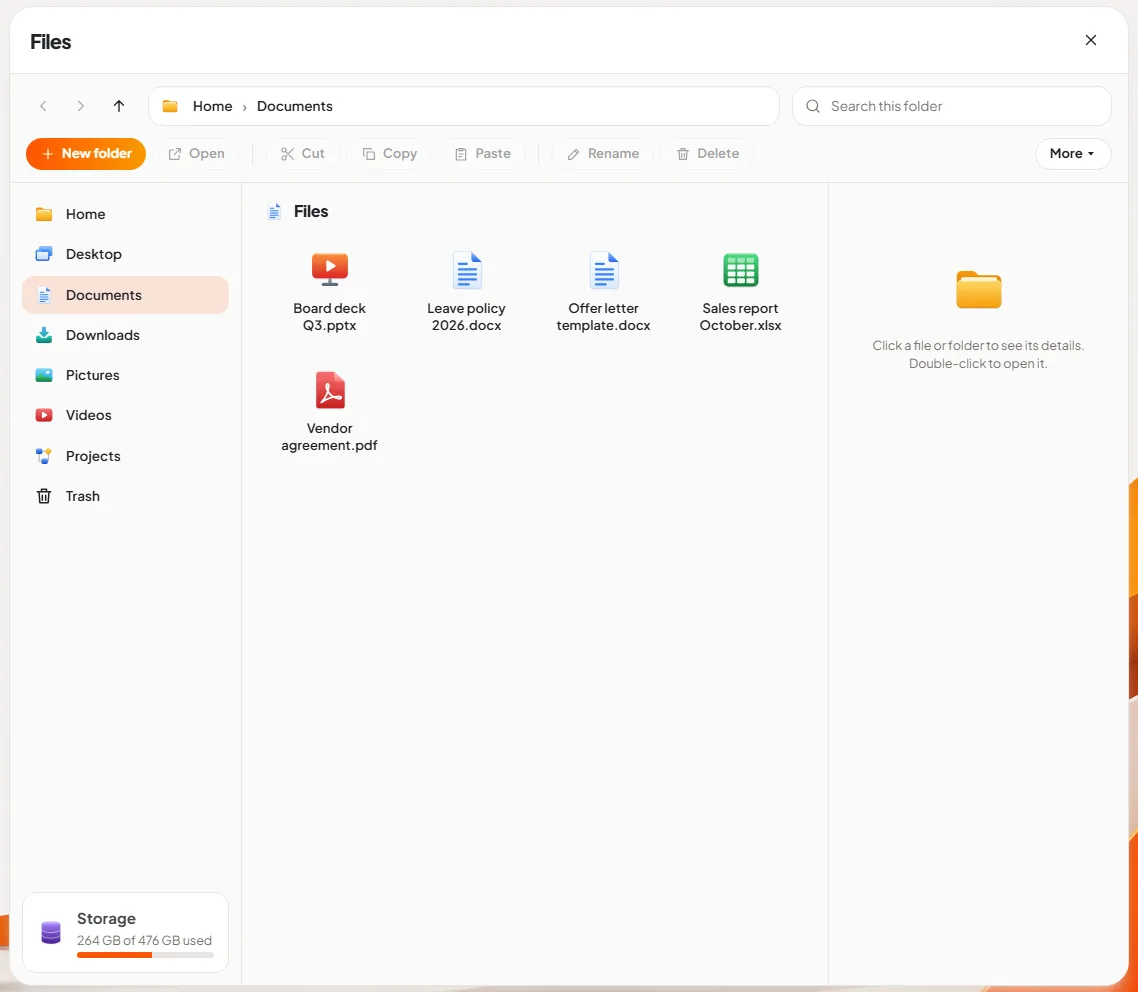
That is the whole of our claim here: the files are standard and they are on your disk, so leaving us would be a matter of copying a folder. We are not going to promise that every complex file looks identical in every suite, because no vendor can. DNX Office explains the test to run, and DNX Files shows where documents live.
DNX OS is in beta from December 2026 and launches in January 2027. To run the ten-file test on it, apply for the beta.
What is still uncertain?
- Whether ODF 1.4 has been adopted by ISO. We could not open ISO's catalogue.
- Schleswig-Holstein's progress since early 2026, and whether the desktop move happened.
- What exactly the International Criminal Court has deployed.
Sources
All sources were opened on 12 November 2026.
- OASIS Open, press release on ODF 1.4, 3 December 2025.
- US Library of Congress, OpenDocument format description, updated 31 March 2025, and OOXML format family, updated 30 May 2024.
- Government of India, Department of Information Technology, Policy on Open Standards for e-Governance, v1.0, November 2010.
- The Document Foundation, German state moving 30,000 PCs to open-source software, 4 April 2024, and Germany committing to ODF, 29 April 2025.
- European Commission, Interoperable Europe Portal, Schleswig-Holstein's open source strategy, a year on, 16 February 2026.
- The Record, Denmark's digital ministry and Microsoft, 13 June 2025, and It's FOSS, update on the Danish pilot, 31 October 2026.
- EJIL:Talk!, Justice recoded: the International Criminal Court and open-source software, 20 November 2025.
- European Commission, Data Act explained, updated 15 December 2025.
Keep reading
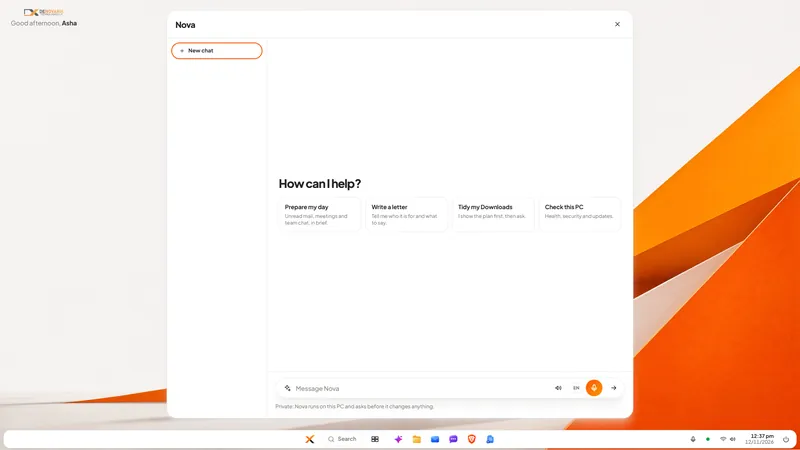
Do you need an AI PC? On-device AI on ordinary PCs
AI PCs need a special chip and 16 GB of RAM, but small language models now run on ordinary office computers too. What on-device AI can and cannot do in 2026.
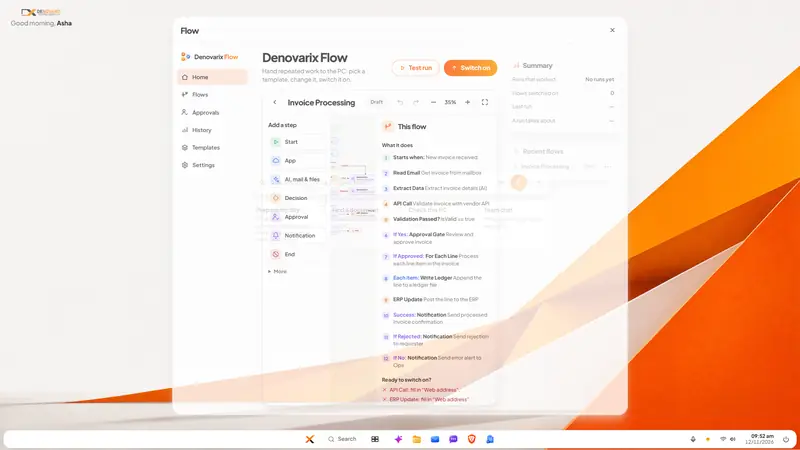
Invoices stuck in approval: how to fix the queue
Supplier invoices wait for days because the approval rule lives in people's heads. Write the rule down, give it one queue and automate the chasing. Steps here.

Attendance and leave on WhatsApp: how to move off
Attendance in a register and leave approved on WhatsApp work until salary day. How a small Indian company moves both into one system, step by step, in a month.