
Sovereign AI and private AI: what they mean in India
Sovereign AI and private AI explained for Indian business owners: who controls the model, where your data goes, and five questions to ask any AI vendor.
Part of the guide: India's technology ecosystem: DPDP, data, sovereign tech

The short answer: private AI means the AI works on your data without that data leaving your control. Sovereign AI is the wider idea: your company, or your country, decides where the AI runs, who can reach it and which law applies to it. For a business, both come down to one test. When an employee asks the AI a question about a client, can you say exactly which computers that question touched?
Both phrases are used loosely in sales decks. This article pins them down so you can tell a real answer from a slogan.
What is private AI?
An AI assistant needs three things to answer a question: the model, a computer to run it on, and your prompt (often with a document attached). "Private" describes what happens to the third.
With a public AI service, your prompt travels to the provider's servers, is processed there and may be stored there. With private AI, the prompt is processed somewhere you control, and nobody outside your company can read it or learn from it.
There are degrees of this, and vendors are not always clear about which one they are selling.
| Level | Where the AI runs | Who could see your prompts | What you rely on |
|---|---|---|---|
| Public service, consumer account | Provider's cloud | The provider, under its consumer terms | Their goodwill |
| Public service, business plan | Provider's cloud | The provider, under a contract that restricts use | A contract |
| Dedicated cloud instance | A cloud region set aside for you | The cloud operator's staff, in principle | A contract and an architecture |
| Your own server | A machine in your office or your data centre | Your own administrators | Your own controls |
| The device itself | The employee's laptop | Nobody else | Physics |
The lower you go in that table, the less you depend on someone else's promise. The first two rows are a matter of trust. The last two are a matter of fact: the data cannot leak from a place it never went.
What is sovereign AI?
Sovereignty adds two questions that privacy alone does not answer.
Whose law applies? Data stored abroad is subject to the law of the country where it sits, as well as Indian law. A company with government, defence, banking or healthcare clients is often asked to show that data stays within India. Even where no rule demands it, clients increasingly ask.
Who can switch it off or change it? If your work depends on an AI service run by a foreign company, that company decides the price, the terms, the model's behaviour and whether the service is available to you at all. Sovereignty means those decisions cannot be made over your head.
For a country, sovereign AI is about national capacity: Indian compute, Indian models, Indian languages. For a company, it is simpler and more practical. It means you could keep working if any one outside vendor changed its mind.
Does the law require Indian companies to keep AI data in India?
Not as a blanket rule, and you should be wary of anyone who says otherwise to sell you something. The Digital Personal Data Protection Act regulates how personal data is processed and gives the Government power to restrict transfers to particular countries. Sector regulators have their own rules for certain kinds of data. Whether any of that binds you depends on your sector and your contracts, and it is a question for your legal adviser.
What the law does make clear is that you remain responsible for personal data even when a vendor processes it for you. An AI service that receives your customers' details is a processor acting on your behalf. If you cannot say where it keeps that data, you cannot show you are looking after it. We cover the practical steps in the DPDP Act checklist.
So the honest position is this: keeping AI processing inside India, on systems you control, is not always legally required, but it turns a set of hard questions into easy ones.
Is private AI as capable as the big public models?
No, not across the board, and a vendor who claims otherwise is overselling.
The largest public models are trained and run on hardware no small company could buy. For open-ended research, long complex reasoning or generating a marketing campaign from nothing, they are ahead.
But most business use of AI is not that. It is summarising a contract, drafting a reply, finding a figure in a spreadsheet, turning a scanned invoice into text, answering "what is our receivables position?" from your own books. Smaller models running locally do this work well, and for this work the constraint was never raw intelligence. It was whether you could safely give the AI the document in the first place.
A private model that is allowed to read the salary sheet is more useful than a brilliant public one that is not. The comparison of on-device AI and cloud AI goes into speed, cost and where each wins.
What should you ask a vendor who says their AI is private or sovereign?
Five questions separate the real thing from the label.
- Where, physically, is my prompt processed? A country is the minimum acceptable answer. "On your own device" or "on your own server" is the best one.
- Is anything I type stored, and for how long? Ask about logs, not only about training.
- Is my data used to improve your models? Ask for the sentence in the contract, not the sentence on the website.
- Which of your staff or subcontractors can access it? Every cloud service has administrators. Find out who they are and where.
- What happens if I disconnect the internet? If the AI stops working, it was never running on your side.
The fifth question is the quickest test of all. Pull the network cable and ask the assistant something.
How does DNX OS approach this?
We built DNX OS around the bottom row of the table above. Nova, its assistant, runs on the laptop's own processor and works on machines with 4 GB of RAM. Each AI service is sandboxed with no network access, so a prompt has no route out of the machine. The company's server, DNX Hub, is hosted on your premises or in an Indian data centre of your choice.
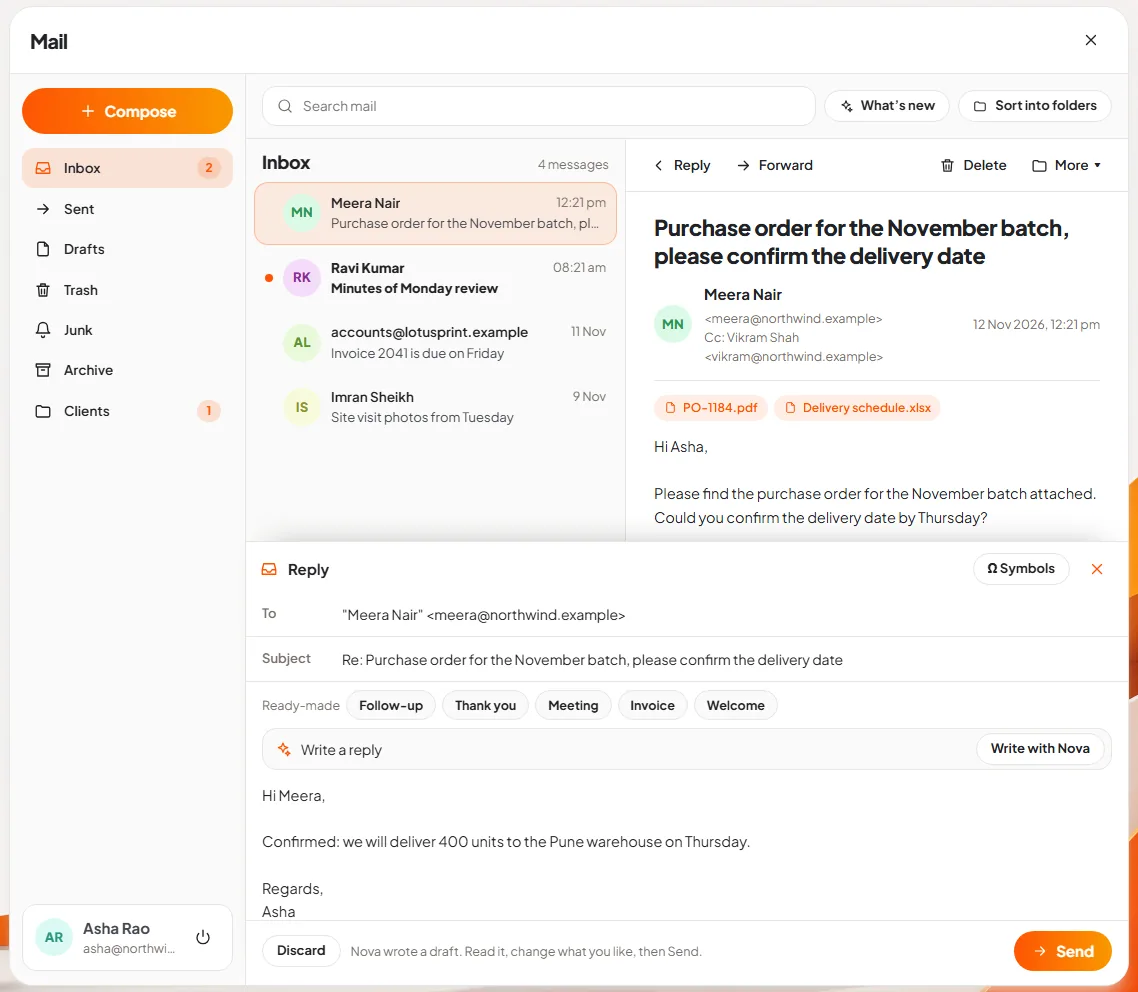
For work that needs larger models, DNX AI Cloud is planned for 2027, hosted in India. It will be an option you turn on, not a dependency.
You do not need our product to apply the idea. Whatever you use, write down where your prompts go. If you cannot, that is the first thing to fix, and our article on shadow AI explains how to start.
Keep reading

What software really costs a 25-person company in India
A worked example of what a 25-person Indian company pays for software subscriptions in a year, with illustrative prices, hidden costs and ways to cut the bill.

On-device AI vs cloud AI for business: how to choose
On-device AI or cloud AI for your business? A plain comparison of speed, cost and privacy, the tasks each one suits, and how to decide which work goes where.

HRMS for small companies in India: what to look for
Choosing HRMS software for a small company in India: the leave, attendance, payroll and statutory features that matter, and the questions to ask every vendor.